
Mid and lower back · Fla. Stat. 627.736
Back Pain After a Car Accident in Daytona Beach
Daytona Accident Chiropractor explains back pain after a car accident in Daytona Beach and across Volusia County, from the mid back between the shoulder blades down to the lumbar spine. Most crash-related back pain is strain and sprain of muscle and ligament, and most of it improves. A small share is fracture or nerve compression that needs an emergency department, and Florida's PIP statute puts a 14-day clock on getting examined either way. This page covers how the injury happens, which symptoms change the plan, and what the first examination is looking for.
- 14 daysfrom the crash to receive initial care, or PIP medical benefits are lost
- $2,500the PIP cap without an emergency medical condition finding
- T12 to L2where seatbelt (Chance) fractures usually occur
- 4 to 6 weekswhen most people with back pain improve or recover, per MedlinePlus
Not medical advice and cannot assess your symptoms. If this may be an emergency, call 911.
Have the free helpline call you
Tell us where to reach you and we will call you about your 14-day PIP deadline and where to start care. Free, no obligation, and we are not a clinic or a law firm.
- Free
- No obligation
- Not a clinic or law firm
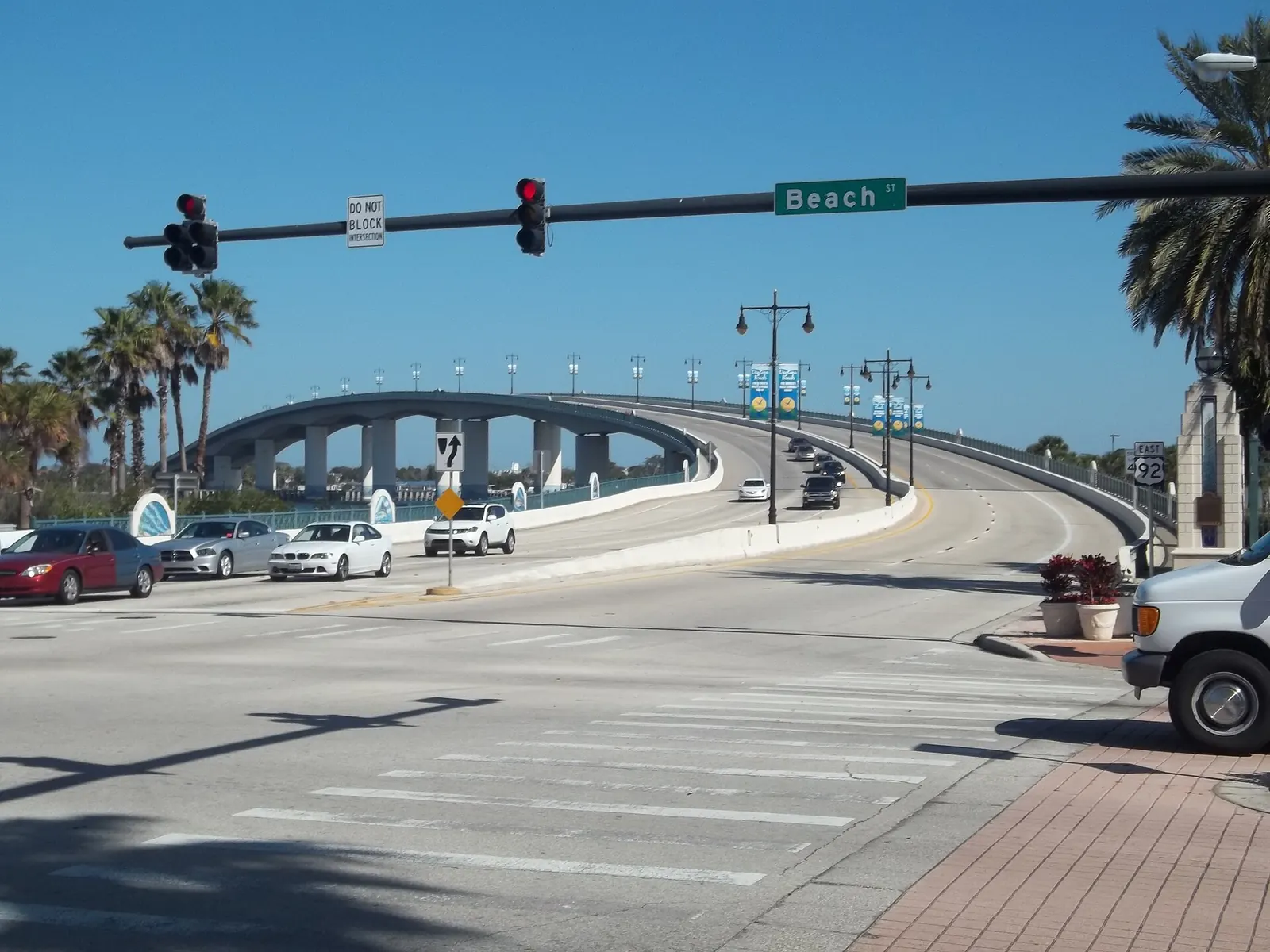
Photo: US 92 at US 1, Daytona Beach. DanTD, CC BY-SA 4.0, via Wikimedia Commons

Why start with the helpline
Start with the call. Two minutes tells you which deadlines are already running against you and where to go next. Free, no obligation.
- Both clocks, in one callThe 14 days to begin care and the deadline on the claim itself start at the crash. The call tells you which one is closest.
- IndependentNot a clinic, not an insurer, not a law firm. Where a licensed clinic advertises here it pays a flat monthly fee, never per patient, call, or appointment.
- The statute, citedThe 14-day rule, the 80% rate and the $10,000 and $2,500 limits come from Fla. Stat. 627.736, and every page names the section.
How a collision loads the mid and lower back
A seatbelt saves lives by holding the body at a few points while everything else keeps moving, and those points are where the spine takes load. A lap belt that sits low across the pelvis spreads force through bone. A lap belt that rides up onto the soft abdomen becomes a fulcrum, and the spine bends forward over it.
Crash researchers reviewing restrained occupants in frontal collisions of moderate severity found that the thoracic and lumbar injuries that did occur clustered in the lower thoracic and upper lumbar spine, most often as burst fractures. They linked isolated fractures to occupants sliding under the lap belt, and noted that these occupants often had abdominal injuries as well, a sign that the belt had loaded the belly rather than the pelvis.
Rotation is the second mechanism. A three-point belt is asymmetric: it crosses one shoulder and not the other. In an angled or side impact the torso moves sideways, and in laboratory testing of far-side impacts the shoulder belt could slip off the shoulder at impact angles greater than 40 degrees from frontal when no pretension was applied. A torso twisting around a single diagonal strap is a plausible route to the sprains that NIAMS, the federal institute for musculoskeletal research, attributes to twisting.
Most of what follows is less dramatic than a fracture. MedlinePlus states that acute low back pain is most often caused by a sudden injury to the muscles and ligaments supporting the back, with muscle spasm, strain, or tearing producing the pain. The soft tissue injury guide covers that tissue in more depth, including the neck.
What commonly shows up, and when
NIAMS describes back pain that can come on suddenly after an accident, and acute back pain that usually lasts a few days to a few weeks. Some people feel it at the roadside. Others first notice it getting out of bed or out of the car days later, which is the pattern described on the delayed pain page.
Lumbar strain and sprain
Aching, tightness, or spasm across the low back that limits bending and turning. Strain is muscle or tendon; sprain is ligament. The most common result and usually the most responsive to time and activity.
Mid back (thoracic) pain
Pain between or below the shoulder blades. The diagonal shoulder belt crosses this region, and the thoracolumbar junction at the bottom of the rib cage is where belt-related fractures concentrate.
Disc injury and sciatica
MedlinePlus lists injury or strain among the causes of a herniated disk. In the lower back it can send sharp pain into the buttock, hip, or leg, with numbness or weakness, the pattern called sciatica.
Fracture
OrthoInfo, from the American Academy of Orthopaedic Surgeons, describes thoracic and lumbar fractures as causing moderate to severe back pain that is worse with movement, sometimes with numbness, tingling, weakness, or bowel and bladder dysfunction.
A fracture changes where you go, and it can hurt in the same places as a strain, which is why the warning signs below come before anything else.
What an examination and imaging look for
A back examination starts with the history: the direction of impact, where you sat, how the belt fit, when each symptom started. NIAMS lists the physical examination as looking at the spine and posture and testing reflexes, muscle strength, and sensation. MedlinePlus adds that a provider will try to pinpoint the location of the pain and how it affects movement, and one of the classic disc tests is simple: leg pain when a straight leg is lifted while seated suggests a herniated disk in the lower back.
| Test | What it shows | What it will not show | When it tends to be used |
|---|---|---|---|
| History and physical examination | Location of pain, movement, reflexes, strength, sensation, nerve tension signs | Fracture lines or soft tissue inside the spine | Every visit, from the first one |
| X-ray | Bones: fractures and changes in spinal alignment | Discs, ligaments, and nerve roots | After trauma, to look for fracture |
| CT | Detailed views of the vertebrae, fracture lines, bone fragments pushed toward the canal | Soft tissue as well as MRI does | Suspected fracture; the gold standard for confirming a Chance fracture |
| MRI | Discs, ligaments, nerve roots, bleeding or compression in the canal | It is not a default test; it is ordered when symptoms point to it | Nerve symptoms, suspected cauda equina, ligament injury around a fracture |
| EMG | Electrical activity in muscle and nerve | Structure | Weakness or numbness where the nerve involved is unclear |
Imaging is not automatic for ordinary back pain. MedlinePlus says a provider usually will not order tests of the spine during the first visit or for 4 to 6 weeks unless certain symptoms are present. A crash is one of the situations that can change that calculation, and OrthoInfo describes trauma patients with suspected thoracic or lumbar fractures being assessed with X-ray, CT, and MRI of several areas. Whether you need a scan is a clinical decision for whoever examines you, and a normal X-ray rules out broken bone rather than injury.
General care approaches, and what the evidence says
Once fracture and nerve compression have been considered, care for crash-related back pain usually draws on a short list of approaches. None of them comes with a guaranteed result, and this page cannot say which suits you.
- Staying active. MedlinePlus says bed rest is not recommended where there is no sign of a serious cause, advises reducing activity only for the first couple of days, and suggests ice for the first 48 to 72 hours, then heat.
- Physical therapy. NIAMS lists it among non-surgical treatments. MedlinePlus notes that starting stretching and strengthening too soon after an injury can make pain worse, which is part of what a therapist decides.
- Spinal manipulation. The NIH's complementary health center reports that the American College of Physicians guideline includes spinal manipulation as an option for acute and subacute low back pain, on low-quality evidence, and that one review found modest improvements in pain at up to 6 weeks. Mild, temporary soreness afterward is common.
- Medication. Over-the-counter pain relievers, anti-inflammatories, and muscle relaxants appear in both NIAMS and MedlinePlus guidance. Which, if any, is a decision for a prescriber.
The prognosis is mostly good and not universally so. MedlinePlus says many people feel better within a week. A 2020 meta-analysis in Accident Analysis and Prevention found that people injured in a crash had 2.7 times the risk of later low back pain compared with people who were not, and cited a one-year prevalence of persistent low back pain of at least 31% among those exposed. A study of adults 65 and older discharged from emergency departments after a crash found that pain in the lower back and legs was among the features associated with pain persisting at six months.
Florida's PIP medical benefit excludes massage therapy and acupuncture outright, whoever provides them, so those two are paid some other way or not at all. How long a course of care tends to run is covered on the treatment length page.

How the 14-day rule and the $10,000 or $2,500 split apply to a back injury
Fla. Stat. 627.736(1)(a) pays PIP medical benefits only if you receive initial services and care within 14 days after the crash. The count runs from the crash date, not from the day your back started hurting, and the 14-day deadline page works through exactly how it is counted.
Meeting the deadline is the first gate. The second is the size of the benefit. PIP reimburses up to $10,000 if a medical doctor, osteopathic physician, dentist, physician assistant, or advanced practice registered nurse has determined you had an emergency medical condition. If a provider determines you did not, reimbursement is limited to $2,500. A licensed chiropractic physician can provide the initial care that satisfies the 14 days, and can provide follow-up care, but is not on the list of providers who make that determination.
Severe pain is in the statutory definition
Fla. Stat. 627.732 defines an emergency medical condition as one with acute symptoms of sufficient severity, which may include severe pain, such that going without immediate medical attention could reasonably be expected to seriously jeopardize health, seriously impair bodily functions, or cause serious dysfunction of a body part. Whether your back pain meets that definition is a clinical judgment. Getting in front of a provider who is allowed to make it is a choice you control.
That is why the order of visits matters for back injuries in particular. A physician-level evaluation first, at an emergency department where red flags exist or urgent care where they do not, settles the deadline and puts the emergency medical condition question in front of someone authorised to answer it. Ongoing chiropractic or physical therapy care can follow on referral. The ER or chiropractor guide lays out that sequence, and the PIP payment guide covers the 80% rate and what is left once the benefit runs out. Riders should read the motorcycle page instead: Fla. Stat. 627.732 defines a motor vehicle as having four or more wheels, so motorcyclists have no PIP to protect.
The back symptoms that mean emergency care now
Do not wait for an appointment if any of the following is true after a crash. Call 911 or go to an emergency department.
- Loss of control over urine or stool, or new trouble starting to urinate
- Numbness in the saddle area, the perineum between the legs
- Weakness or numbness in the buttocks, thigh, leg, or pelvis, or difficulty walking or keeping your balance
- Pain traveling down the legs below the knee, especially in both legs
- Back pain after a severe blow or a high-energy crash, or pain severe enough that you cannot get comfortable
- Unexplained fever with back pain
- Belly pain, bruising across the abdomen where the lap belt sat, dizziness, or fainting
Most of that list comes straight from the MedlinePlus guidance on acute low back pain, which tells readers to contact a provider right away for these signs. After a collision, right away means an emergency department, because trauma is the context that raises the stakes.
Cauda equina syndrome
The nerve roots at the bottom of the spinal canal can be compressed by a large disc herniation or by a burst fracture or fracture-dislocation. A 2026 review in Cureus describes the classic picture as pain down both legs, saddle numbness, bladder and bowel dysfunction, and leg weakness, calls MRI the diagnostic gold standard, and reports that decompression within 48 hours is associated with better bladder, motor, sensory, and sexual outcomes. It is uncommon. It is also the reason bladder changes after a crash are never a wait-and-see symptom.
The abdominal item belongs on a back page for a specific reason. A Chance fracture, the seatbelt fracture, is a flexion injury across the lap belt, and a 2025 review in Radiology Case Reports notes its strong association with intra-abdominal injury, reported at 23% in adults and 63% in children. Back pain with belly pain after a crash is an emergency department visit, not a chiropractic one.
The first week
What should you do in the first week after a crash?
Four things protect both your health and the claim. None of them requires a lawyer or a referral.
Get examined inside the 14 days
An emergency room, urgent care, a physician, a dentist, or a licensed chiropractic physician all satisfy the statute. Tell whoever sees you that the visit is because of a motor vehicle crash, and give the date. Intake staff record the reason for the visit from what you say, and a chart that does not connect your symptoms to the collision hands an adjuster an easy argument.
Describe every symptom, not just the worst one
Symptoms you do not mention do not enter the record. A complaint that first appears six weeks later reads very differently from one documented on day two, and the gap between the crash date and the first treatment date is the most attacked fact in any injury claim.
Notify your own insurer promptly
Your policy requires timely notice, and your PIP is the first payer regardless of fault. Report the facts: when, where, which vehicles, visible damage, and that you are under medical evaluation.
Keep the paperwork in one place
Discharge summaries, receipts, the crash report number, and any record of missed work. Reconstructing this at month four is far harder than collecting it in week one.
Verify any provider's licence before treatment. Florida's Department of Health publishes a public licence lookup for every regulated health profession. It takes under a minute and is worth doing regardless of who referred you.
Questions
Questions about Back Pain After a Car Accident in Daytona Beach
Is it normal for my lower back to hurt more a few days after a Daytona Beach crash?
It can happen. Strain and sprain of the muscles and ligaments supporting the back is the usual cause of sudden low back pain, and while some people feel it at the scene, others first notice it later, the pattern covered on the delayed pain page. What matters is the 14-day PIP clock, which runs from the crash date whatever your back is doing, and the red flags on this page, which mean emergency care at any point.
Which back symptoms after a Volusia County crash mean I should call 911?
Loss of bladder or bowel control, numbness in the saddle area, weakness or numbness in the legs, pain running down both legs, difficulty walking, fever with back pain, severe pain after a high-energy crash, or back pain together with belly pain or abdominal bruising. These can signal fracture, nerve compression, or internal injury.
Will I need an X-ray or MRI for back pain after a Daytona Beach car accident?
That depends on the examination. For ordinary back pain, MedlinePlus says imaging is usually not ordered at the first visit or for 4 to 6 weeks unless certain symptoms are present. After a crash, suspected fracture points toward X-ray or CT, and nerve symptoms or suspected ligament injury point toward MRI. The examiner makes that call.
Can a chiropractor treat back pain from a Volusia County crash under PIP?
Yes. Fla. Stat. 627.736 names licensed chiropractic physicians among the providers whose initial care satisfies the 14-day requirement, and among those who can provide follow-up care. A chiropractor cannot make the emergency medical condition determination, so without a physician-level finding the benefit is capped at $2,500 rather than $10,000.
How long does back pain after a Daytona Beach crash usually last?
Nobody can predict an individual case from a web page. MedlinePlus says many people with acute low back pain feel better within a week and most improve or recover within 4 to 6 weeks. Research on crash-injured people also finds that a meaningful share still have low back pain a year later, which is one reason to keep the first record accurate and complete.
Does a seatbelt bruise across my stomach matter if only my back hurts after a Volusia County crash?
Yes. The seatbelt fracture of the lower thoracic or upper lumbar spine is strongly associated with injury inside the abdomen, and abdominal injury can feel mild at first. Back pain with belly pain or bruising where the lap belt sat belongs in an emergency department.
Primary sources: Fla. Stat. 627.736 (the 14-day initial care requirement, qualifying and follow-up providers including licensed chiropractic physicians, the emergency medical condition determination and the providers authorised to make it, the $10,000 and $2,500 limits, the 80% rate, the massage and acupuncture exclusion) and Fla. Stat. 627.732 (definitions of emergency medical condition and motor vehicle), text at Online Sunshine. Medical sources: MedlinePlus, acute low back pain; MedlinePlus, herniated disk; OrthoInfo, fractures of the thoracic and lumbar spine; OrthoInfo, low back pain; NIAMS, back pain and diagnosis and treatment; NCCIH, low-back pain and complementary health approaches; Cureus 2026, cauda equina syndrome review; Radiology Case Reports 2025, Chance fracture review; Richards et al. 2006, thoracic and lumbar injuries in restrained occupants; Douglas et al. 2007, far-side belt interaction; Nolet et al. 2020, crash exposure and future back pain; Platts-Mills et al. 2016, persistent pain after a crash in older adults. General information only. This page is not medical advice, does not diagnose, and does not describe or predict any individual case; treatment decisions belong with a licensed provider. If this may be an emergency, call 911. Last reviewed September 23, 2026.
Service areas
Does the 14-day deadline apply everywhere in Volusia County?
Fla. Stat. 627.736 is a state statute, so the deadline does not change with the address on the crash report, from the beachside to west Volusia.
Also written for: Ponce Inlet, Oak Hill, DeBary, Lake Helen and Pierson.
The map shows the county this site writes about. It is not an office: there is no clinic or treatment room at that point or anywhere else.
The deadline that decides your benefits
Florida gives you 14 days from the crash to start medical care.
Miss it and up to $10,000 in Personal Injury Protection benefits is forfeited under Fla. Stat. 627.736. The statute contains no hardship exception, and no provider or attorney can restore the benefit afterward. It runs from the crash date, weekends included, whether or not symptoms have appeared yet.
If anyone may be seriously hurt, call 911 first.